
Chasing Joy: A Painting Process (and All the Do-Overs That Come with It)
Updated: Jun 9

Figure 1. The finished painting. The goal was to express joy through bold color, energetic movement, and strong yellow-blue contrasts.
If you've ever stared at a blank canvas and thought, "Now what?” you’re not alone.
Painting rarely starts with perfect execution. It starts with an idea, followed by experimentation, uncertainty, and often a surprising number of do-overs.
I wanted to share the process behind one of my recent paintings—not because it went smoothly, but because it didn't. The challenges, revisions, and moments of doubt became some of the most valuable parts of the journey.
The painting began with a single idea: joy.
The Idea
Every painting starts somewhere.
Sometimes it's a landscape, a photograph, or something you've seen in a magazine. At other times, it's simply a feeling. You may be trying to express excitement, sadness, calmness, wonder—or, in this case, joy.
For this painting, I wasn't working from a reference photo. Instead, I wanted to explore big, bold shapes and strong color relationships, especially yellow-orange against blue.
The goal wasn't realism.
The goal was energy, playfulness, movement, and that wonderful feeling of being alive.
Starting with Thumbnails
Before beginning the large canvas, I created a series of thumbnail sketches.
These small studies allowed me to experiment with composition, value patterns, movement, and color placement without committing too much time or paint.
Figure 2. Early thumbnail sketches exploring composition, movement, focal points, and color relationships.

Figure 3. Additional thumbnail studies explored pathways, focal points, and the balance between large shapes and smaller accents.
One lesson became obvious almost immediately: proportion matters. My thumbnails didn't exactly match the proportions of the final 30" x 40" canvas. That created challenges later and required some adjustments. It was a reminder that solving compositional problems early can save a great deal of frustration later.
Still, I loved the energy in these thumbnails. They felt spontaneous, playful, and full of possibility.
When the Painting Doesn't Match the Sketch
Then came the difficult part.
As I began blocking in the large painting, something wasn't working.
The energy that existed in the thumbnails seemed to disappear. The large blue tree shape became increasingly dominant and started taking over the composition.
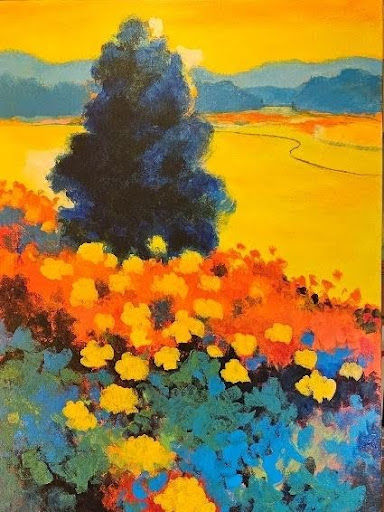
Figure 4. An early version of the painting. The large blue shape became too dominant and overwhelmed the sense of joy I was trying to create.
This happens more often than artists like to admit.
One of the biggest lessons in painting from imagination is learning to let go of what isn't working, even when you've already invested time and effort.
Painting from imagination is rarely a straight line. You're building the image while simultaneously evaluating it, which means constant adjustments, corrections, and occasional reinvention.
Sometimes the answer is simply to paint over it and keep going.
The Turning Point
After multiple revisions, one important change shifted the painting in a new direction.
I added a bright yellow bush in front of the large blue shape.

Figure 5. Adding the yellow bush created balance and introduced a stronger focal point. This was the first moment the painting began moving toward the feeling I wanted.
Suddenly, there was balance.
The yellow bush created a focal point, added visual excitement, and began to restore the feeling of joy that had been missing.
The painting wasn't finished, but it finally felt like it was heading in the right direction.
An Unexpected Detour: Along the way, another version emerged.

Figure 6.A softer variation emerged during the process. While I loved its gentleness, it lacked the energy I was seeking. The idea may become a future painting of its own.
I actually liked this version quite a bit. It felt gentle, peaceful, and reflective. But it wasn't joyful in the way I had originally imagined.
This became an important realization: a painting can be successful and still not accomplish your original intent.
Although I ultimately moved away from this version, it sparked ideas for a future painting centered on gentleness rather than joy. Sometimes the roads you don't take become inspiration for later work.
The Push and Pull of the Process
The process became a cycle of:
Try something.
Step back.
Evaluate.
Adjust.
Repeat.
Again and again.
Some changes have improved the painting. Others revealed new problems. Each revision helped clarify what the painting wanted to become.
More importantly, each revision helped clarify what joy meant to me visually.
The Finish (Finally)
After many paint-overs, adjustments, and long periods of looking, the painting finally began to feel complete.

Figure 7. The completed painting after many revisions, adjustments, and paint-overs.
At the end of the day, my hope is simple:
That the viewer feels a sense of joy. That feeling was the spark behind the painting from the very beginning. And perhaps the biggest lesson from this entire process is this:
Struggling with a painting doesn't mean you're doing it wrong. It means you're doing the work.
The frustration, the uncertainty, the revisions, and the moments when nothing seems to be working are all part of developing your artistic eye and finding your own voice.
So keep going.
Paint over it.
Try again.


Comments